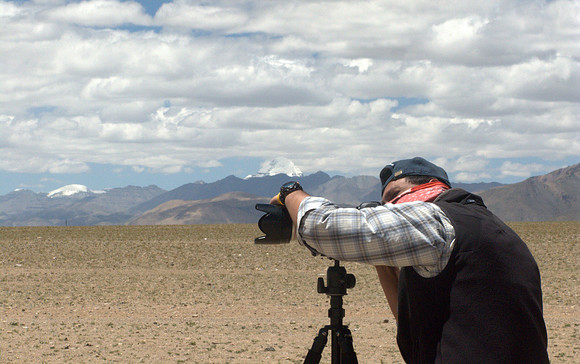
Lake Manasarovar, North Western Himalayas, Tibet [4,635 m/15,207 ft]
This was taken by my dad as I was photographing on the banks of Lake Manasarovar. Mount Kailash is the prominent peak visible in the background at the center of the image.
Both Lake Manasarovar [Sanskrit:मानस सरोवर] and Mount Kailash hold significant relevance to two religions that formed the basis of some of most important ancient civilizations of the world, whose traditions have remained intact for several thousands of years: Hinduism & Buddhism. Lake Manasarovar is one of the two high altitude fresh water lakes that lies South of Mount Kailash, the other being Rakastal. "Manas" derived from Sanskrit meaning "cognition" or "enlightenment" and "sarovar" meaning "lake", while "Rakas" also derived from Sanskrit meaning "demon" and "tal" means "lake".
The location and juxtaposition of these two lakes places an important role in Hindu mythology where in Manasarovar being a nearly perfect circular lake represents forces of light, while Lake Rakastal being curved like the crescent moon represents the hidden forces of the night. Their position relative to Mount Kailash implying that Lord Shiva overlooks both good and evil in this world. Buddhists also associate the lake to the legendary lake known as Anavatapta in Sanskrit, where QueenMaya is believed to have conceived Buddha.